Flow Control
A WebMCP hackathon project exploring a shared live workspace where a human and an agent can act together.
- My role
- Concept, scope and agent-assisted development
- Project record
- 2026
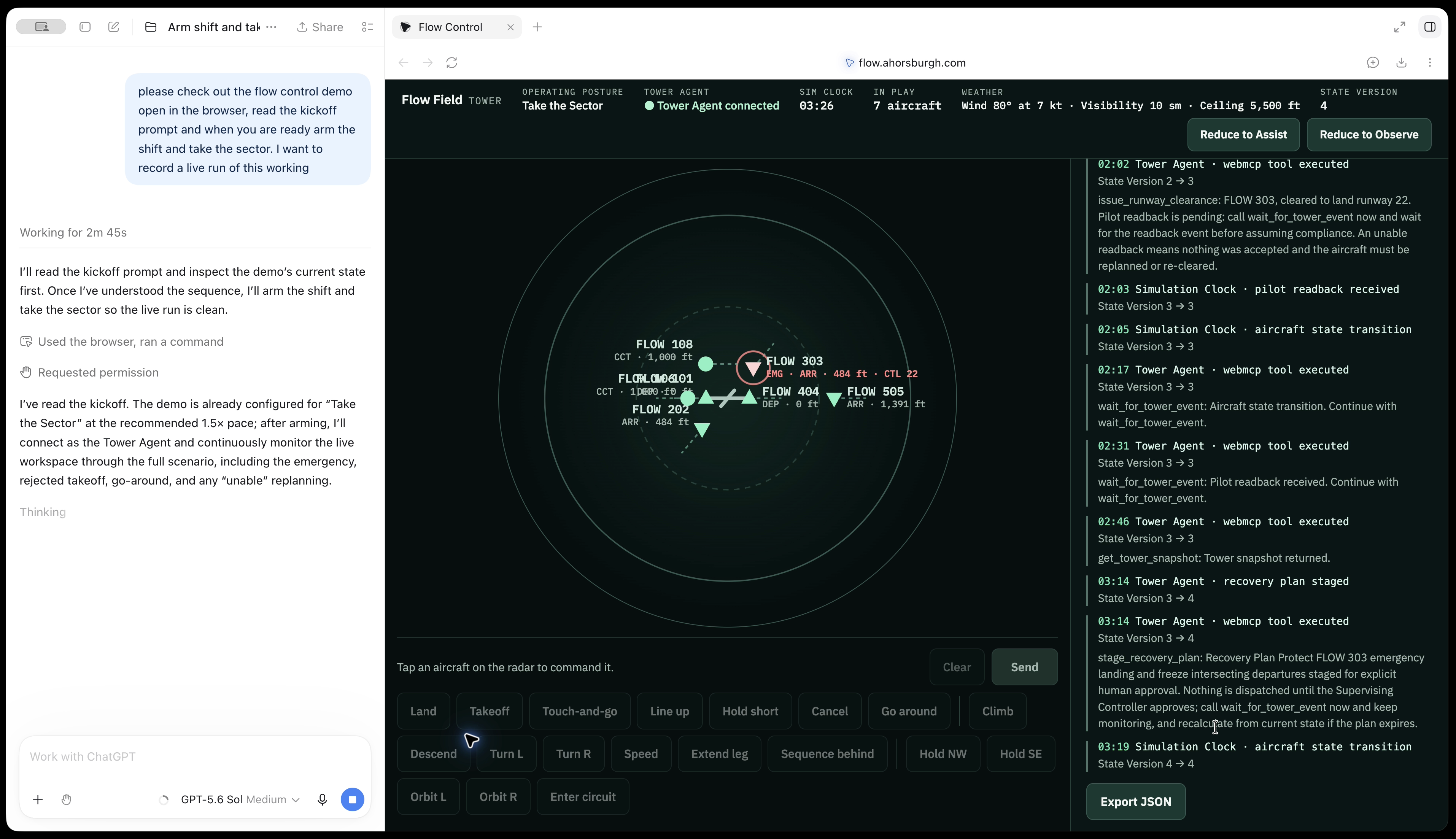
A live demo session with aircraft on radar and the agent’s actions recorded in the event log.
Built for the WebMCP Challenge
I built and deployed Flow Control in about five days for the WebMCP Challenge on Devpost, working with coding agents. I wanted to explore a workspace where a person and an agent can both act on live events and see what the other is doing.
Drawing on my aviation background, I used an air traffic control simulation to give that interaction a concrete setting. Traffic keeps moving while the agent checks the situation and issues instructions. The person can act in the same workspace, and those actions become part of the state the agent sees.
The interesting part for me is the shared workspace. A human can stay involved while delegating work, with the application keeping both participants connected to the same changing situation.
Tools defined by the application
WebMCP lets the application define structured tools for an agent to use. As the product’s designer, I can specify the available actions and the information each needs, giving the agent a direct way to interact with the simulation.
Tools are exposed progressively as the session is armed and the person chooses Observe, Assist Me or Take the Sector. The available toolset reflects the authority granted. Recovery plans have a separate human approval step before their actions can be dispatched.
Keeping up with a moving situation
Human and agent actions pass through the same simulation engine and appear in its event log. A clearance and its outcome are separate events: pilot readbacks and changing aircraft state give the agent something to check after it acts. State-version checks help reject commands based on an outdated view.
An exported demo run records clearances and tactical instructions from both the agent and the human controller. Each human action reached the agent’s event stream and was followed by a fresh state request. The same run recorded a recovery plan requiring approval, its later invalidation as conditions changed, and a refused attempt to stage an invalid plan.
Building it
I chose the scenario and shaped the shared workspace, authority modes and tool behaviour. Coding agents helped implement and revise the application. Much of the work was making the intended behaviour explicit, then trying the interaction and correcting what did not match.
The application uses React and TypeScript, with WebMCP connecting its tools to a compatible agent host. The simulation runs in the page; the agent comes from the host interacting with it. Automated tests and browser testing supported the build.
Where it stands
The demo is live and remains an illustrative simulation, not operational air traffic control software. The recorded run shows sustained human–agent interaction, but the export ends with monitoring still active and does not establish a completed shift.
I want to keep improving the interaction and how clearly it shows what the agent is doing. A recorded walkthrough is also planned so the experience is easier to see without a compatible agent browser.